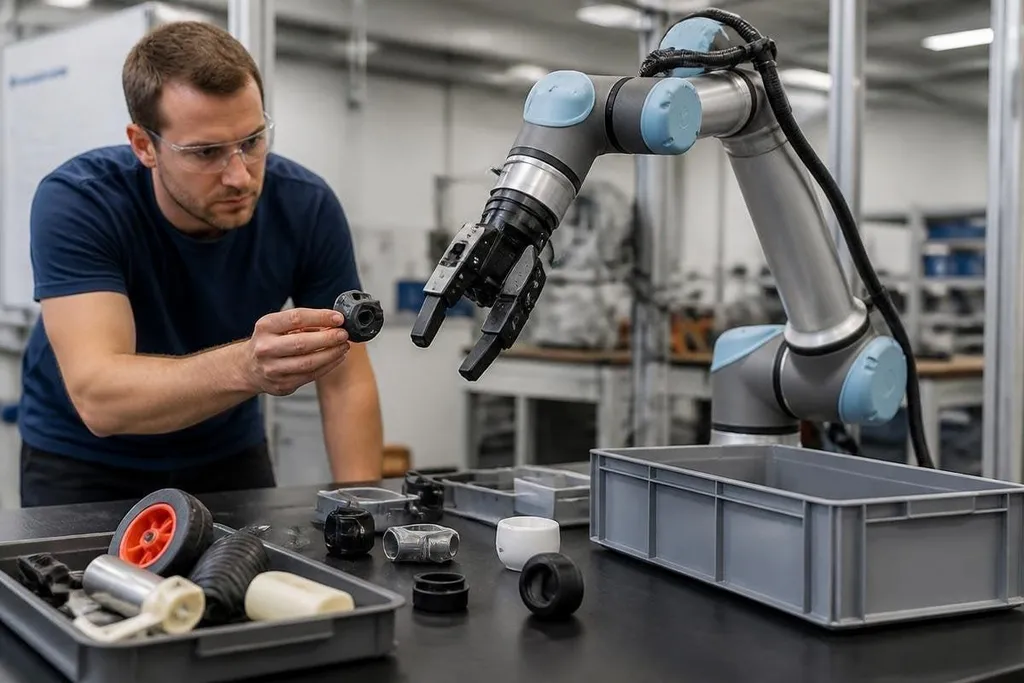
Factory robots can move a box across a factory floor with little trouble. Picking up a soft pouch, turning a small part, or sliding a cable into a socket demands much more control. For companies building automation, the hard work now sits at the robot’s hand.
- Grip changes: A useful hand must adjust force when an object bends, slips, or shifts.
- Vision falls short: Cameras show shape and position, but they don’t fully show contact or pressure.
- Small errors matter: A few millimeters can stop a plug, screw, or gear from fitting.
Why hands are difficult to control
A fixed gripper works well when every object arrives in the same position. Dexterity matters when the robot must handle parts that vary in size, weight, texture, or pose.
The robot needs to find the object, choose a grip, move its fingers, and react when the contact changes.
That reaction is the hard part. A motor can close a finger with a set amount of force, but the correct force depends on the object. Too little force lets it fall. Too much can crush thin plastic, bend a part, or damage a surface.
Humans get this feedback through touch, pressure, joint position, and sight. The hand needs related data from cameras, motor sensors, force sensors, or tactile sensors. Software then has to turn those signals into small changes in finger position and grip force while the task is under way.
The hand also has several joints that affect one another. Moving one finger can change the object’s position, which changes the angle needed by another finger. A small control error can spread through the whole motion.
The factory problem is variation
Many automation systems work because the factory removes variation. Parts arrive in trays, tools stay in one place, and the robot repeats a known path. That approach keeps the control problem small, but it limits the tasks the system can handle.
Dexterity becomes useful when a robot must work with mixed items or deal with parts that are not placed perfectly. A system may need to pick a cable from a bin, hold a component while another tool works, or rotate an object until its shape matches a fixture. Each task adds contact points and possible errors.
Speed matters too. A robot that succeeds once after several slow attempts
may still lose money in production. Engineers need to measure the full task: failed picks, recovery moves, part damage, pauses for human help, and the time needed to reset the cell.
A hand that picks one part well may still fail when the part shifts, tilts, or arrives touching another part. Robot24.com can give you dated reports on the machine, task, and result behind a dexterity claim before the next section asks what still needs proof.
What still needs proof
Manufacturers can show a robot picking one object in a controlled video. That proves the hand can perform that motion under those conditions. It doesn’t prove the system can repeat the task across a full shift with changing parts, dust, glare, worn surfaces, and brief sensor errors.
The missing evidence is often operational. You need the task success rate, the number of human interventions, the time per completed part, and the cost of damaged items. You also need to know how the robot responds when it fails, since a safe recovery can matter more than a perfect first attempt.
Training adds another limit. Recorded demonstrations or simulated data may teach a motion, but the physical hand still has to deal with friction, flexible materials, contact force, and wear. Those details are hard to reproduce exactly outside the real work cell.
I’d judge a dexterous robot by its recovery rate, not its most polished demonstration.
A buying check for dexterity projects
Use these questions before choosing a hand or starting a pilot:
- Name the objects: Record the full range of sizes, materials, weights, and surface conditions.
- Set the task limit: Define the allowed cycle time and the number of failed attempts per shift.
- Check the sensors: Confirm how the system detects slip, contact force, position, and blocked motion.
- Test recovery: Remove an object, change its angle, or place it slightly out of position.
- Count human help: Log every pause that needs a person to reset, guide, or inspect the task.
A dexterous hand earns its place when it handles normal variation without turning each error into a service call. The next useful proof will be a production record that shows task success, cycle time, recovery rate, and hand wear over a full shift.